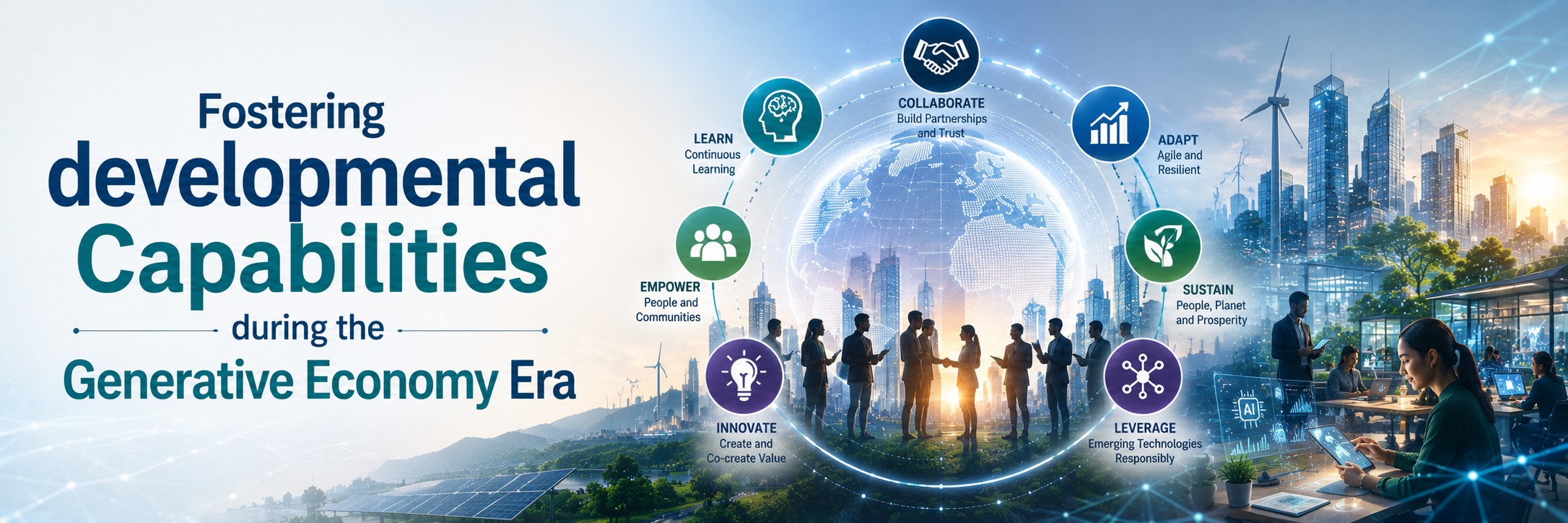
TRACK TOPIC:
Fostering developmental Capabilities during the Generative Economy Era
|
|
CHAIRS
|

Gianpaolo Basile
Universitas Meracatorum, Italy |

Mario Tani
University of Naples "Federico II", Italy |
|

Maria Palazzo
Universitas Meracatorum, Italy |
|
|
Artificial
intelligence
(AI) is driving
the second wave
of digital
transformation
and adjusting
the working
world.
Advancements in
digital
technologies are
engendering a
transformation
in human and
business
activities,
forming the
basis for the
fourth
industrial
revolution.
Today, AI is
arguably the
most dominant
technological
paradigm and
certainly a
“pervasive
economic and
organizational
phenomenon”,
whose associated
opportunities
and challenges
are critically
important for
management and
marketing
researchers.
Currently, the
technological
and business
communities are
paying
increasing
attention to
Generative
Artificial
Intelligence (GenAI):
a form of AI
that can drive
innovation by
enabling new
co-production
and co-creation,
and by
developing
societal
components that
require “react(ion)”
capabilities in
the management
and marketing
fields. This
condition is
moving economic
events toward a
generative
condition that
changes the
temporal
dimension from a
linear process (Chronos)
marked by the
clock, calendar,
or other tool,
to a “right
time” (Kairos)
that signals the
moment in which
relations are
born, adapt, and
co-produce
outcomes. This
view is
considered
heterochrony by
historians, who
argue that time
operates
differently
across places,
eras and
contextual
conditions. In
this vein, it is
likely most
useful to
entrepreneurship
scholars for
understanding
the adaptation
conditions,
represented by
management and
marketing
activities, in
temporal
orientations and
the effects
these
differences have
on teams and on
relations with
heterogeneous
stakeholders.
This track aims
to deliver
answers to the
following
questions:
How might
heterochrony
among team
members and
stakeholders in
relations help
achieve
performance
goals?
In new
industries with
few precedents
for
entrepreneurial
action, are
entrepreneurs
under the same
time pressure as
in mature, more
competitive
industries?
Which could be
the role of AI
in reducing
uncertainty,
stimulating
management and
marketing
reactions more
than strategy?
Key themes and
discussions in
this track will
include (but are
not limited to):
-The temporal
dimension in
marketing and
management
studies
-
The effectuation
or causation of
business
behaviours
-The role of
generative AI
and the temporal
dimension in the
evolution of
management and
marketing
studies .
|