|
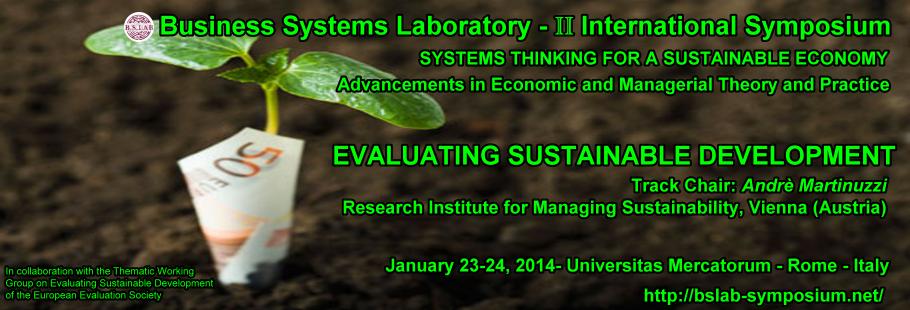
Scope:
This track will bring together researchers and practitioners to share
their experiences and gain greater insight into the prospects and
challenges of using systems thinking in sustainable development
evaluations.
Background:
The guiding vision of sustainable development poses several
challenges to researchers, evaluators and client organizations:
-
the focus on future generations requires evaluation methods with a
comparably long time horizon;
-
the principle of public participation requires evaluation methods and
processes which can accommodate involvement, empowerment and learning of
a wide range of stakeholders;
-
the holistic principle requires sound aggregation and valuation
methods to achieve a well-balanced assessment of environmental, economic
and societal impacts and their trade-offs;
-
the global perspective requires tracking of long lived and systemic
effects.
While the US-based debate puts a special emphasis on evaluation
approaches, methods and tools (Stufflebeam 2001), the European
discussion on sustainability evaluations focuses mostly on content
related issues and general principles of sustainable development (Martinuzzi
2011).
One issue that could bridge both communities is systems thinking: in
the evaluation community systems thinking became an important approach
to overcome over-simplified intervention logics and to increase the
chances for implementing evaluation results (Hargreaves & Podems 2012).
In the debate about sustainable development systems thinking
highlights bounded rationality, limited certainty, limited
predictability, indeterminate causality, and evolutionary change (Hjorth
& Bagheri, 2006).
PRESENTATIONS
Friday 24 - Room "Master" - 14,30 - 19,00
-
Linking the debates about Sustainable Development, Evaluation and
Systems Thinking - Andrč Martinuzzi (Vienna University of
Economics and Business, Austria);
-
A benchmarking model for sustainable tourist destinations -
Giuseppe Tardivo, Angela Scilla, Milena Viassone (University of
Turin, Italy);
-
Sustainable enterprise excellence systems: The SEER2
strategy & performance model - Rick Edgeman (Aarhus
University, Denmark);
-
Is environmental certification useful to evaluate sustainable
development? - Nicolň Passeri, Barbara Pancino, Silvio Franco
(University of Tuscia, Italy);
-
New Method to address Sustainable Development in Theory Based
Evaluations – Systemic Constellations - Ursula Kopp (Vienna
University of Economics and Business, Austria);
-
Real options as sustainable business evaluation method in the biotech
and med-tech industry. A qualitative and empirical approach -
Giacomo Büchi, Cecilia Casalegno (University of Turin, Italy), Fabrizio
Conicella, Audey Dayon (Bioindustry Park Silvano Fumero SpA, Italy),
Michela Pellicelli (University of Pavia, Italy), Roberto
Schiesari (University of Turin, Italy);
-
Measuring corporate social responsibility performance: balanced and
dynamic rating system - Elena Escrig-Olmedo, María Jesús
Muńoz-Torres, María Ángeles Fernández-Izquierdo, Juana María
Rivera-Lirio (University Jaume I, Spain);
-
Water Basin Policy Ex-ante Assessment: Methodology of Achieving
Cost-effective Solutions in Pollution Reduction Plans - Petr
Šauer, Petr Fiala, Antonín Dvořák (University of Economics Prague,
Czech Republic);
-
A systemic method for evaluating how sustainable is the development
of a country or a region - Francisco Aceves, Rolando Jimenez, J.
Antonio Urbano (IPN, Mexico);
-
21st Century Malls & Sůqs: Towards a Resilient Future
- Fodil Fadli (Qatar University, Qatar).
|