|


10th Business Systems Laboratory International SymposiumMASTERING CHALLENGES:Navigating the Waves of Innovation in a Tech-Driven World |
|||||
 |
|||||
January 22-23,
2026
|
|
||
|
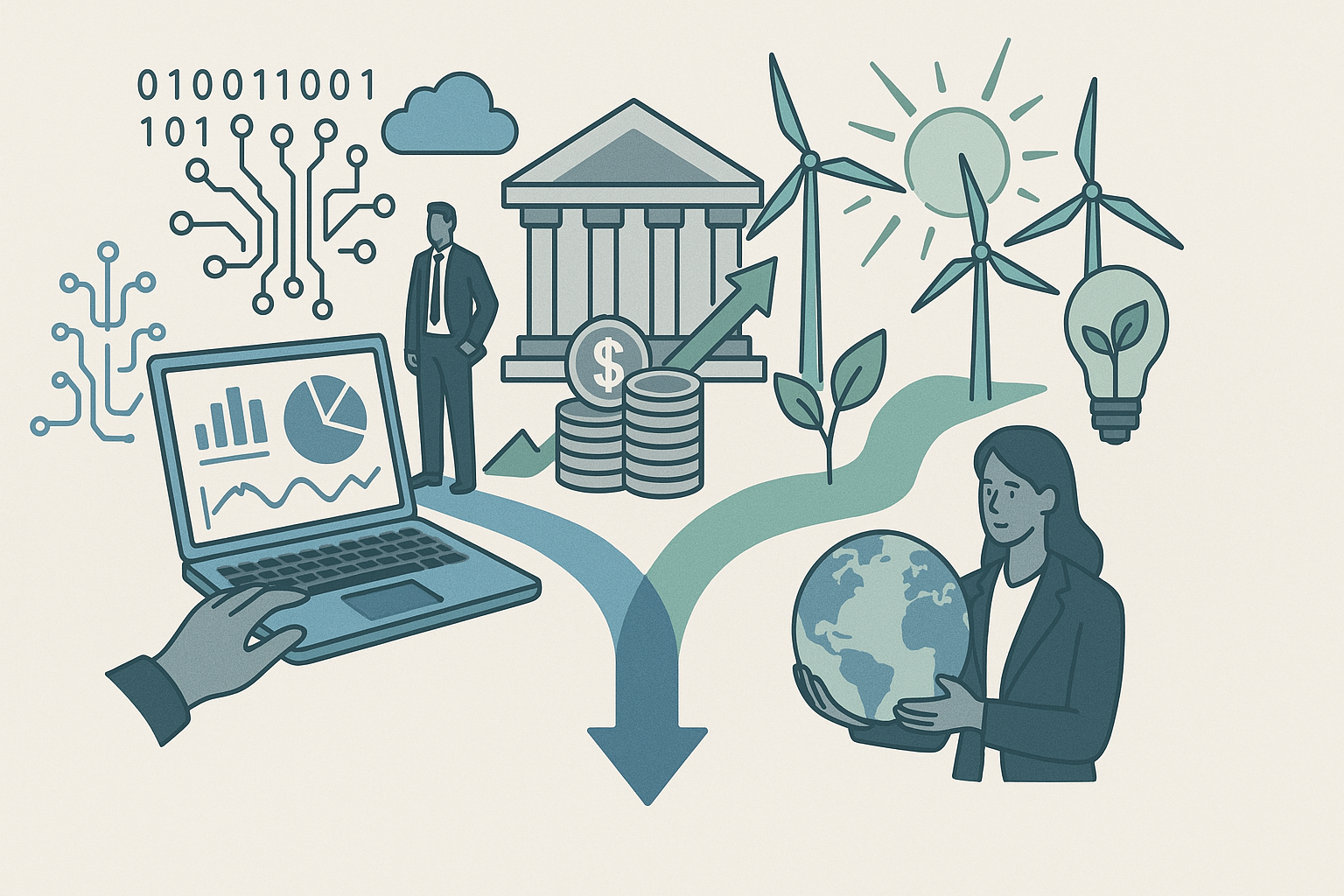
Track description The global economy is undergoing a profound transformation driven by two concurrent and interdependent shifts: digital transition and green transition, collectively known as twin transition. These parallel trajectories are reshaping the foundations of economic activity, compelling businesses, financial institutions, and policymakers to rethink traditional approaches and develop innovative responses. This track aims to explore the complex implications of the twin transition across three critical domains: financial markets, business models, and public policy. Financial markets are being transformed by the twin transition. Green and digital finance, ESG investing, climate risk disclosure, and fintech innovation are influencing capital flows and risk assessment frameworks which are challenging traditional valuation paradigms. Understanding how financial systems adapt to this dual shift is vital for forecasting long-term economic stability and growth. As digital technologies redefine the operational landscape, businesses must align these innovations with the urgent need for environmental sustainability. This convergence calls for the redesign of business models to incorporate circular economy principles, sustainable strategies, and digitally enabled efficiencies while maintaining competitiveness. Regulatory frameworks, fiscal incentives, and innovation policies must evolve to foster synergy between digitalization and sustainability, while ensuring social equity and economic inclusivity. Policymakers face the complex task of designing interventions that not only enable transformation, but also manage its disruptive consequences on industry structures and regional development. This track welcomes interdisciplinary contributions that offer theoretical insights, empirical analyses, case studies, or policy evaluations related to the twin transition. The topics of interest include (but are not limited to): - Challenges of energy transition; - Financial inclusion and digital transition; - Financial education and social engineering - Sustainable digital entrepreneurship; - Financing green innovation; - Governance of digital platforms; - The role of AI in twin transition; - Transition risks and opportunities for legacy industries. By fostering dialogue among scholars, practitioners, and policymakers, this track aims to generate actionable knowledge on how to leverage the twin transition for a more sustainable, inclusive, and digitally empowered economic future.
|
||
|
|