|


10th Business Systems Laboratory International SymposiumMASTERING CHALLENGES:Navigating the Waves of Innovation in a Tech-Driven World |
|||||
 |
|||||
January 22-23,
2026
|
|
||
|
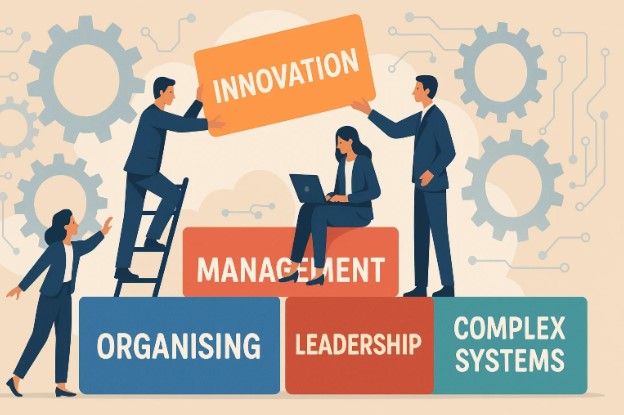
Track description In today’s increasingly uncertain environment, organisations must continuously evolve to survive and thrive. Innovation has become not just a strategic imperative but a systemic necessity, driving the ability of organisations to navigate environmental turbulence, stakeholder expectations, global crises, and rapidly shifting institutional landscapes (AlSaied & Alkhoraif, 2024; Rezaei et al., 2024). At the heart of this transformation lies a critical re-examination of how we manage organisations, develop and utilise knowledge, and build learning capacity across all levels of the enterprise. This track invites scholars, practitioners, and interdisciplinary researchers to explore the dynamic interplay between management, innovation, and organisational learning, particularly in the context of complex, adaptive systems (Mooradian, 2024; Aggarwal et al., 2024). Rather than focusing solely on technological innovation, this track aims to address broader questions: • How do organisations learn and unlearn in the face of systemic change? • What forms of leadership and decision-making foster adaptive capacity? • Which leadership styles and decision-making processes are conducive to dynamic adaptation? • What systemic approaches enable organisational resilience and sustainability? The track is grounded in the belief that innovation is not only a technological phenomenon but also a social, cognitive, and structural process deeply embedded in organisational culture, routines, structures, and values (Demastus et al., 2025). As such, understanding innovation requires a nuanced, systemic lens that spans organisational sciences, systems theory, behavioural insights, and strategic management. This track seeks to explore how organisations, be they public, private, hybrid, or non-profit, can rethink traditional paradigms of management and leadership in ways that enhance their innovative capabilities and long-term relevance. It offers a space to investigate both the enablers and barriers of innovation from a holistic perspective, from internal dynamics like organisational learning and culture to external factors such as regulatory complexity, social change, or ecological disruption. We particularly welcome contributions that embrace methodological plurality, from qualitative ethnographies, action research, and case studies to quantitative modelling, longitudinal studies, mixed methods or literature reviews. Research conducted across various sectors of corporate, governmental, educational, healthcare, technological, and third-sector organisations is strongly encouraged to ensure a broad, comparative, and transdisciplinary dialogue. We invite papers that engage with, but are not limited to, the following themes: • Strategies for navigating emergent challenges and systemic disruptions • Strategic and systemic management approaches to fostering innovation • Designing flexible structures that foster continuous renewal • Leadership, governance, and decision-making in complex systems • Cultural, ethical, and behavioural enablers of organisational adaptability • Processes of sensemaking that spur creativity and learning • Innovation processes across sectors: public, private, non-profit, and hybrid • Interdisciplinary approaches linking systems thinking, organisational theory, and behaviour • Organizational responses to paradoxes, tensions, and uncertainty • Methods for studying complexity in organisational contexts (qualitative, quantitative, mixed)
References Aggarwal, A., Baker, H. K., & Joshi, N. A. (2024). Organizational innovation as business strategy: A review and Bibliometric analysis. Journal of the Knowledge Economy, 1-27. AlSaied, M. K., & Alkhoraif, A. A. (2024). The role of organizational learning and innovative organizational culture for ambidextrous innovation. The Learning Organization, 31(2), 205-226. Demastus, J., Ohsowski, B. M., & Landrum, N. E. (2025). Exploring the nexus of organisational culture and sustainability for green innovation. Industry and Innovation, 32(1), 108-138. Mooradian, N. (2024). Is Knowledge Management (Finally) Extractive?–Fuller’s Argument Revisited in the Age of AI. Interdisciplinary Journal of Information, Knowledge, and Management, 19. Rezaei, M., Pironti, M. and Quaglia, R. (2024), "AI in knowledge sharing, which ethical challenges are raised in decision-making processes for organisations?", Management Decision, Vol. ahead-of-print No. ahead-of-print. https://doi.org/10.1108/MD-10-2023-2023.
|
||
|
|